[CHAPTER 3] – THE WEDDING SHE TOLD ME TO LEAVE
CHAPTER 3 – THE COST OF STAYING SILENT
Daniel did not come home with me.
I refused to let him.
Not because I wanted him to return to Tiffany.
And not because I had forgiven what happened.
I refused because a forty-year-old man should not leave one woman’s house because of conflict and immediately move into his mother’s.
He needed to decide who he was without either of us standing beside him.
We sat in his car in the venue parking lot instead.
The windshield reflected strings of wedding lights from the building behind us.
Guests moved past carrying coats and gift bags.
Some glanced toward the car.
Most politely pretended not to.
For a long time Daniel said nothing.
Then he began crying.
I had seen my son cry when his grandfather died.
When our old Labrador had to be put down.
When he tore his shoulder during college baseball and realized the game he loved would never be part of his future.
This was different.
He bent forward with both hands covering his face.
“I’m sorry.”
I looked through the windshield.
“I know.”
“No.”
He shook his head.
“You don’t.”
He lowered his hands.
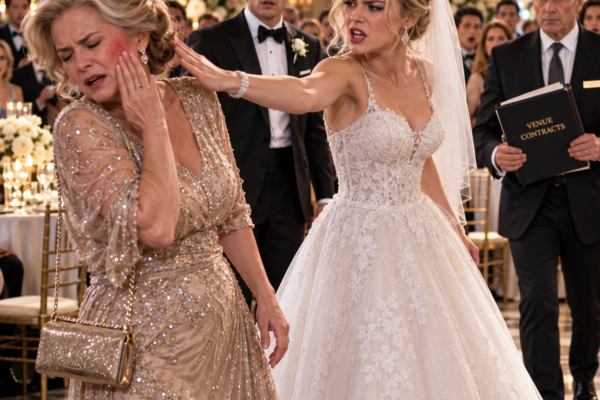
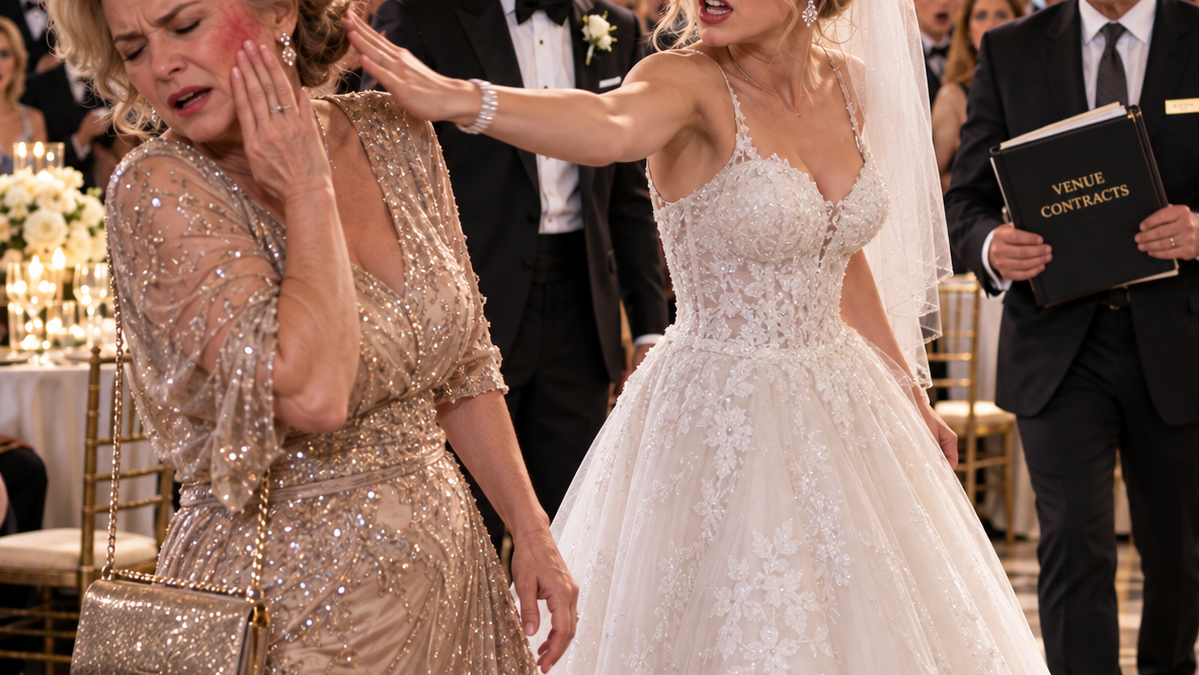
“I saw her hit you.”
My throat tightened.
“I know.”
“And I froze.”
“Yes.”
“I don’t even know why.”
I finally turned toward him.
“I think you do.”
He stared at me.
I waited.
Daniel swallowed.
“Because I knew if I defended you, Tiffany would say I chose you over her.”
There it was.
The truth.
Not flattering.
Not comfortable.
But honest.
“How long have you been afraid of that?”
His eyes dropped.
“A while.”
“How long?”
He took a breath.
“Since before we got engaged.”
I leaned back.
He continued.
“It started with little things.”
He rubbed his palms together.
“If I called you twice in one week, she’d joke that I needed to cut the cord.”
I said nothing.
“If Dad asked me to help with something, she’d say my family always expected me to drop everything.”
My heart sank.
“If you invited us to dinner and I said yes before checking with her, we’d fight.”
“Daniel…”
“I know.”
“No. I don’t think you do.”
He looked at me.
“You stopped calling.”
His face tightened.
“I thought you were busy.”
“I was trying to give you space because every time we spoke, I felt like I had done something wrong afterward.”
He looked away.
“Tiffany said you didn’t respect us as adults.”
I nodded slowly.
“So I tried harder.”
That hurt him.
I could see it.
He had interpreted my distance as proof Tiffany was right.
I had interpreted his distance as the natural progression of a son building a marriage.
And between those two misunderstandings, somebody else had gained control of the story.
Daniel looked back toward the ballroom.
“I thought once we were married, she’d feel secure.”
“That is not how insecurity works.”
“I know that now.”
“No.”
I touched his sleeve.
“You’re beginning to know it.”
He nodded.
I could have told him to leave her.
Part of me wanted to.
I could have told him a woman who struck his mother in public would someday turn that rage on him.
Maybe that would happen.
Maybe it wouldn’t.
But if Daniel made his next decision only because I told him to, then nothing had really changed.
“You need to decide what happens next without asking what I want.”
He wiped his face.
“What if what I want keeps changing?”
“Then don’t make permanent promises while you’re confused.”
He nodded.
After a moment he asked, “Are you pressing charges?”
I looked at him.
He immediately looked ashamed for asking.
“I’m sorry. That sounded like—”
“I know what you meant.”
I touched my cheek.
The swelling was minor.
The humiliation was not.
“I haven’t decided.”
He nodded again.
“Whatever you decide, I’ll tell the truth.”
That mattered.
More than he knew.
We parted in the parking lot.
Daniel booked a room at another hotel.
I went home.
At 2:13 in the morning, my phone lit up.
Tiffany.
I did not answer.
She called twice more.
Then a message arrived.
You got what you wanted.
I stared at it.
For three years, I had been accused of wanting something I had never asked for.
Control.
Daniel back.
Their relationship damaged.
A place above his wife.
I typed several responses.
Deleted every one.
Finally, I wrote only:
I wanted my son to be happy. I still do.
Then I turned off my phone.
The next morning, there was a knock at my door.
Daniel stood outside.
He looked as though he hadn’t slept.
He carried a folder.
I recognized it immediately.
The same style of folder the venue manager had used.
“Can I come in?”
I stepped aside.
He sat at my kitchen table.
For several minutes he stared at the folder.
Then he opened it.
Inside were bank statements.
Credit card records.
Loan documents.
Receipts.
“I spent half the night going through everything.”
I sat across from him.
“You don’t need to show me your finances.”
“I think you need to see why last night happened.”
He slid one statement toward me.
There were repeated transfers from Daniel’s personal savings into their joint account.
“That’s normal,” I said.
“Keep reading.”
I did.
The money was leaving again.
Payments to accounts I didn’t recognize.
Cash transfers.
A jewelry store.
A luxury retailer.
A personal loan service.
Then one transfer stood out.
$4,500.
The same one Daniel had discovered at the venue.
“What is this?”
“Tiffany’s mother.”
I looked at him.
“She told me it was a temporary loan.”
“For what?”
“She wouldn’t tell me.”
Daniel pulled out another page.
“She finally did this morning.”
I waited.
“Her parents didn’t contribute what she told us they contributed.”
I frowned.
“What do you mean?”
“You remember the twelve thousand dollars Tiffany said they put toward the wedding?”
“Yes.”
“They didn’t.”
I stared at him.
“She moved money from our joint savings into another account, then transferred it back through her mother so it looked like her family’s contribution.”
For a moment I did not understand.
“Why?”
Daniel laughed without humor.
“Because she was embarrassed.”
The word landed strangely after everything.
“Her parents couldn’t afford what she told everyone they were paying.”
“So she invented it?”
“She said she didn’t want your side of the family thinking hers couldn’t keep up.”
I looked at the papers.
Suddenly the forty-five-thousand-dollar wedding seemed less like a celebration and more like an expensive stage set constructed around people being terrified of what everyone else might think.
Daniel continued.
“She also put several wedding upgrades on my card without telling me.”
“How much?”
“Almost eleven thousand by this morning.”
I closed my eyes.
“Daniel.”
“I know.”
“Can you cover it?”
“Yes.”
He answered immediately.
“I’m not ruined.”
That relieved me.
“But that isn’t the point.”
“No.”
He looked exhausted.
“The point is that I didn’t know.”
I nodded.
He pulled one more item from the folder.
A handwritten list.
I recognized Tiffany’s handwriting.
At the top:
THINGS THAT NEED TO CHANGE AFTER WEDDING
Daniel looked at me.
“I found it in her planner.”
I did not want to read it.
He slid it across the table anyway.
First item:
Separate holidays.
Second:
No unplanned calls with his mother.
Third:
Daniel handles all communication with parents.
Fourth:
Do not give Margaret keys to future house.
Fifth:
Encourage move farther away within two years.
I stopped.
Daniel watched my face.
“Keep going.”
“I don’t need to.”
“There’s one more.”
I looked down.
Sixth:
Make sure inheritance documents list spouse first.
I pushed the paper away.
The kitchen became very quiet.
Daniel leaned back.
“I asked her about it.”
“What did she say?”
“That married couples are supposed to prioritize each other.”
“That part is true.”
He stared at me.
I continued.
“But prioritizing a spouse and isolating someone from everyone else are not the same thing.”
“I know.”
He looked toward the window.
“She kept saying you were the problem.”
I said nothing.
“And eventually I stopped checking.”
His voice became quieter.
“I just assumed every disagreement somehow started with you.”
I swallowed.
“That was easier.”
He looked at me.
“Easier than what?”
“Admitting you had chosen someone who might not be treating you well.”
His eyes filled again.
“I feel stupid.”
“Don’t.”
“How can you say that?”
“Because shame makes people hide.”
I touched the folder.
“And hiding is how people get trapped longer.”
He sat with that.
Then he asked, “Would you hate me if I tried counseling with her?”
The question surprised me.
“No.”
He looked at me carefully.
“You wouldn’t?”
“I would hate it if you stayed because you were afraid to admit the marriage was a mistake.”
I paused.
“And I would hate it if you ended your marriage just to prove you finally chose me.”
He looked down.
“This needs to be your decision.”
Counseling lasted five weeks.
I know because Daniel told me afterward.
I never asked for details.
The marriage ended anyway.
Not because I demanded it.
Not because of the canceled bar.
Not because of the hotel suite.
According to Daniel, it ended during the fourth counseling session when Tiffany admitted that the slap itself did not bother her nearly as much as the consequences afterward.
She believed the true betrayal was Daniel failing to defend her after I canceled the services.
The counselor apparently asked one question.
“If Margaret had no financial connection to the wedding, would striking her have been acceptable?”
Tiffany did not answer.
Daniel said that silence changed everything.
Their separation became permanent several weeks later.
The financial mess was untangled.
Daniel paid what was legitimately his.
Tiffany took responsibility for debts she had concealed.
The marriage dissolution proceeded privately.
I never posted about it.
Never told distant relatives details.
Never contacted Tiffany again.
She apologized to me once.
A handwritten letter arrived six months later.
It was not perfect.
There were explanations in it that sounded suspiciously close to excuses.
Stress.
Pressure.
Fear.
Family expectations.
But one sentence felt honest.
I treated your love for Daniel as competition because I did not understand that love was not a limited resource.
I kept that sentence.
Not the letter.
Just that sentence.
Because I thought she was finally right about something.
Daniel and I did not immediately return to normal.
There was no normal left to return to.
That was actually good.
We built something better.
He called because he wanted to.
I stopped pretending things didn’t hurt just to make his life easier.
We learned how to disagree without disappearing from each other.
He dated again eventually.
The first woman he brought to dinner was named Rachel.
I was terrified of liking her too much.
So naturally, I became painfully formal.
After dessert, Rachel followed me into the kitchen.
“Can I ask you something?”
“Of course.”
“Does Daniel think you’re scary?”
I laughed so hard I nearly dropped a plate.
From the dining room Daniel shouted, “I heard that.”
Rachel shouted back, “Good.”
It was the first time in years that a woman beside my son did not seem threatened by the fact that he loved his mother.
I liked her immediately.
Two years after the wedding, Daniel asked Rachel to marry him.
He told me over coffee.
Then he slid an envelope across the table.
My stomach tightened.
“What’s this?”
“Open it.”
Inside was an invitation.
Simple.
Cream paper.
A small ceremony.
Forty-two guests.
I smiled.
“It’s beautiful.”
“There’s something on the back.”
I turned it over.
A handwritten note.
Mom,
This time your only job is to show up.
I looked at him.
Daniel smiled nervously.
“No deposits.”
I laughed through tears.
“No contracts.”
“None.”
“No transportation?”
“Already handled.”
“No hotel?”
“No.”
“No emergency brunch authorization?”
He grinned.
“Absolutely not.”
Then his expression softened.
“I want you there because you’re my mother.”
That was all I had ever wanted.
At the ceremony months later, I sat in the second row.
Not the first.
Rachel’s grandmother needed easier access to the aisle, and I had happily traded seats.
Nobody interpreted it as disrespect.
Nobody measured affection by chairs, invoices, or photographs.
When Daniel saw me before the ceremony, he walked over.
He kissed my cheek.
The same cheek Tiffany had struck two years earlier.
“You okay?”
I smiled.
“Perfect.”
He started walking away.
Then stopped.
“Mom?”
“Yes?”
“I should have moved.”
I knew exactly what he meant.
Six feet.
That was the distance between us when Tiffany struck me.
For years afterward, Daniel remembered those six feet more clearly than any detail of the wedding.
I stood.
He looked confused.
I closed the distance myself and hugged him.
“You move now.”
His arms tightened around me.
“I’m sorry it took me so long.”
I pulled back.
“So am I.”
Then I smiled.
“But you moved.”
The music began.
Daniel took his place.
Rachel appeared at the end of the aisle.
And this time, when my son looked toward the woman he was about to marry, he did not look frightened.
He looked peaceful.
I sat down.
There were no contracts in my purse.
No checks waiting to be signed.
No services that depended on my approval.
For the first time at one of my son’s weddings, I had paid for absolutely nothing.
And somehow, I had never felt more certain that I belonged.